Overview
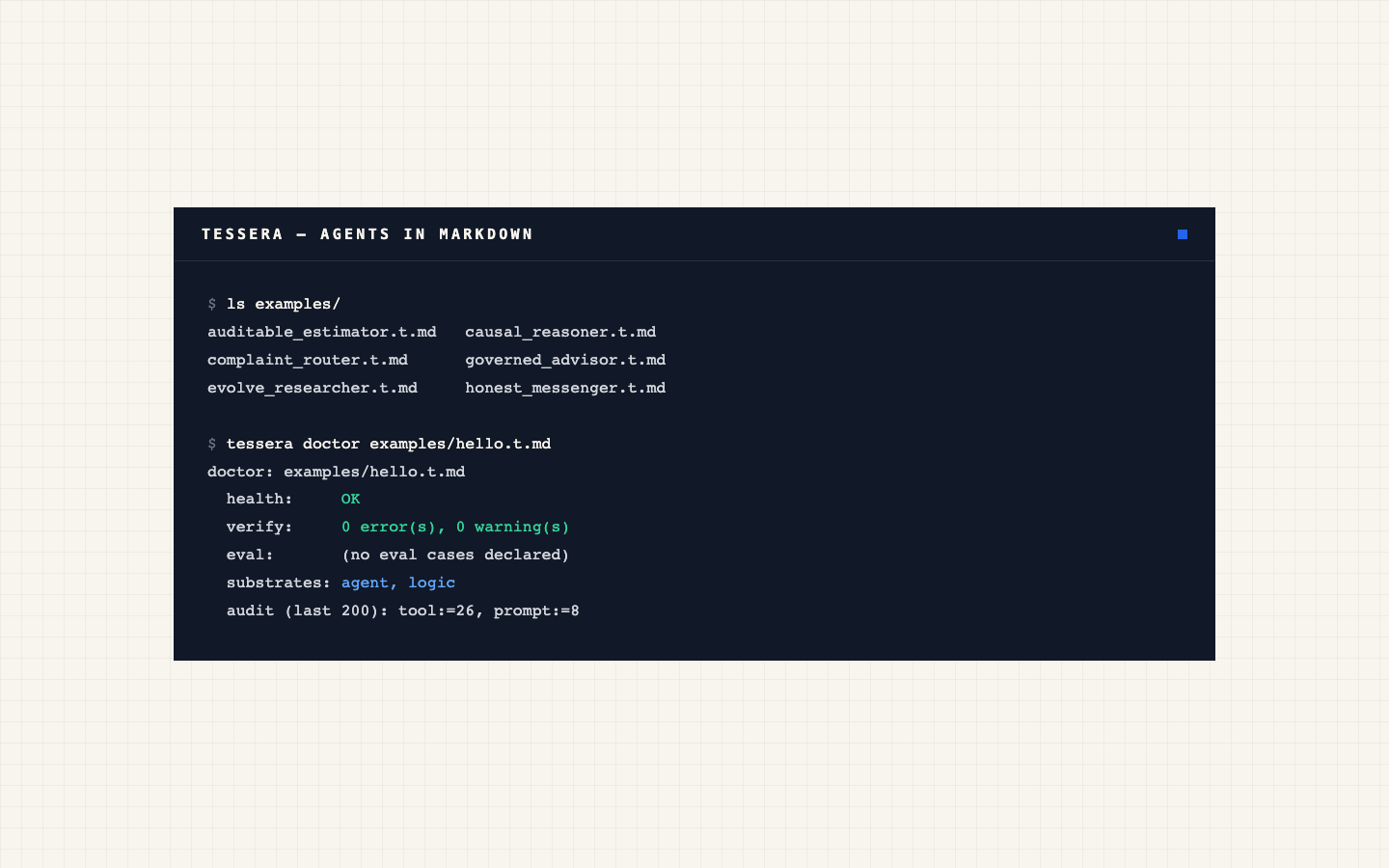
Tessera is a programming language where the markdown file IS the program. Each .t.md file is simultaneously a runnable agent, a browsable Obsidian note, and a formally-verifiable safety boundary. Agents are written as substrate-tagged code fences — logic, agent, memory, prompt, tool, neural — and the compiler enforces the boundaries between them. It lives at the center of a five-system ecosystem: AEON verifies the agent, Synapse persists its memory, Obsidian is where it's written, and Ollama/Anthropic/LangChain/PyTorch do the heavy lifting.
The Challenge
Building an AI agent shouldn't require five frameworks, three vendor SDKs, and a vector database to babysit. Agent behavior ends up scattered across files and prompt strings nobody can read or verify — and there's no way to prove an agent is safe before you run it in production.
The Solution
Make markdown the substrate. A .t.md file compiles to a Substrate IR that AEON's 73 engines verify the same way they verify Python or Rust — catching capability leaks and PII egress before the agent ever runs. Substrate fences declare named modes of thinking; capability grants in frontmatter propagate to every region and are enforced at compile, spawn, and runtime.